Diagram of Canopy design:
Existing Block (below)

Typical 2-Story Dwelling Floor Plate (below)

Depth of typical multi-story row home (+/- 29 feet). This depth allowed for maximum daylight into row homes.
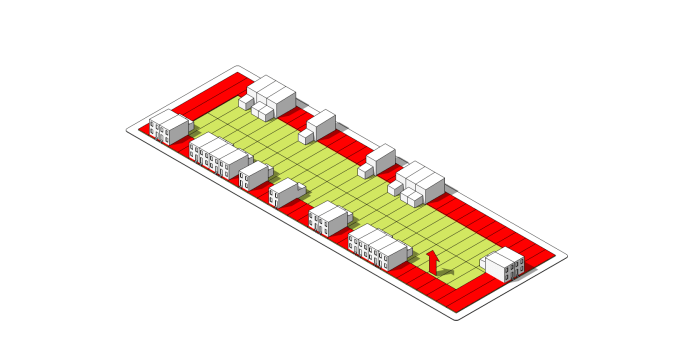
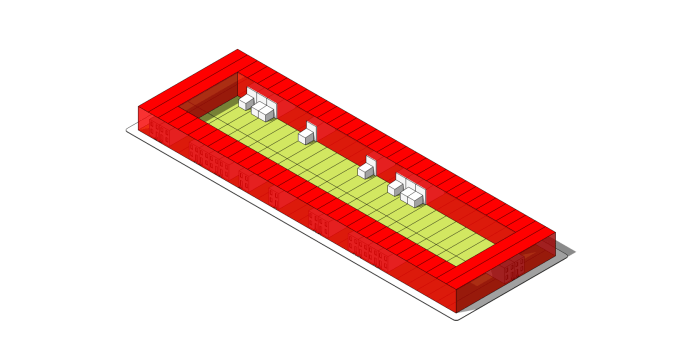
The Canopy is based on the 29 feet depth. This coincided with the typical width of two row homes (14 1/2 feet each).
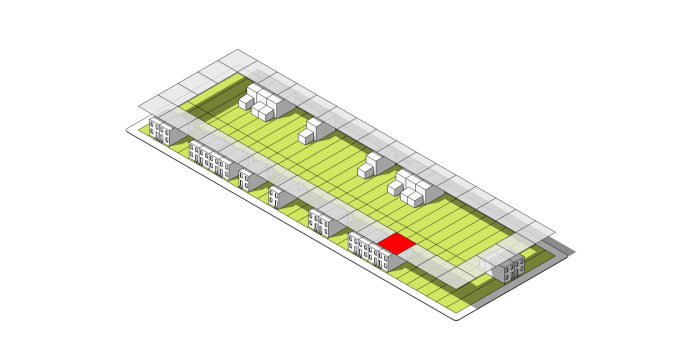

I broke the 29 feet square module into smaller parts in order to create a system of modular plugins.
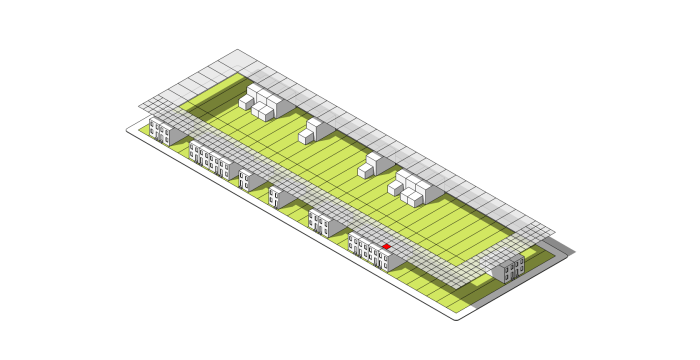
The modular plugins informed the structural grid (below).

The structural grid of the canopy then needed a vertical support. These will most likely require diagonal bracing when the canopies are installed as stand-alone structures (below).

The modular plugins will include gardens, solar panels, skylights, and open frames to allow for a variety of configurations (below).


 neil ryan young
I really appreciate these series of diagrams as a means for beginning to illustrate the evolution of your prototypical canopy design and provide a clear starting point for illustrating the basic metrics provided by this modular system. A couple questions: What sets your standard height/datum of your canopy – maximum zoning code allowance or is it arbitrary? What’s the advantage of keeping the canopy datum at an “urban” or “block” scale versus allowing the canopy datum to react to specific conditions within each block, thus providing a more intimate scale of public covering/shelter at moments? In other words, your canopy structure has the potential of oscillating between the urban and the intimate – creating a topography of its own, responding to the global factors/energy sources and the local, social energies on the sidewalk.
LikeLike